


Is Arabic Hard to Learn for English-Speaking Children?
May 21, 2026 • By Redparrot
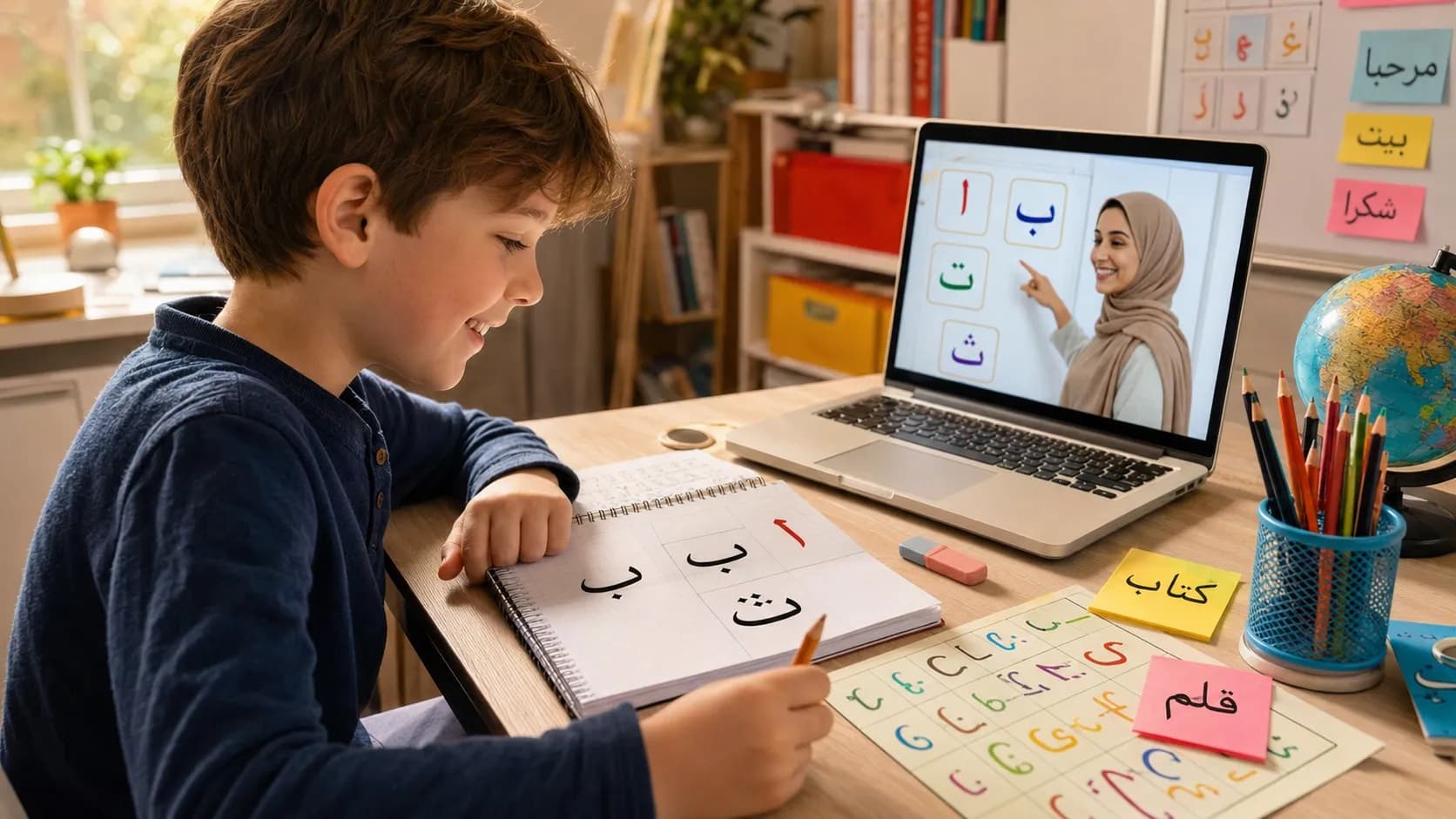
Is Arabic Hard to Learn for English-Speaking Children?
Every parent I speak to eventually asks the same question: is Arabic actually hard for kids, or does it just seem that way? It is a fair concern. Arabic looks nothing like English, sounds quite different, and carries a reputation for being one of the world's more complex languages. But after working closely with young learners and seeing so many children go from complete beginners to confident readers and speakers, my honest answer is that it depends far more on the approach than on the language itself. The script, the sounds, and the grammar all require adjustment. But with the right teacher and the right structure, English-speaking children adapt faster than most parents expect.
How Different Is Arabic From English?
Arabic and English sit on opposite ends of the linguistic spectrum. English uses a 26-letter Latin alphabet written left to right. Arabic, on the other hand, uses a 28-letter abjad script written right to left, where most letters change shape depending on where they appear in a word. Phonetically, Arabic contains sounds that don't exist in English at all, like the guttural ع (ayn) and the emphatic ح (ha), being two that English-speaking children will have never produced before. Grammatically, Arabic uses a root-based word system where three-letter roots generate entire families of related words, which is completely foreign to how English works.
The U.S. Foreign Service Institute classifies Arabic as a Category IV language, its most difficult tier for English speakers, estimating about 2,200 class hours for adult fluency. However, this estimate is based on adult learning patterns. Children learn differently and often make progress more naturally.
What Makes Arabic Harder for English-Speaking Children
Children possess what linguists call critical period plasticity, a neurological window, roughly up to age 12, during which the brain is exceptionally receptive to acquiring new sound systems, scripts, and grammatical patterns. An adult learning Arabic fights against years of deeply wired phonological habits. A child aged five or seven is still building those habits and can integrate Arabic sounds in naturally with English ones.
I've seen this firsthand. Young children don't overthink pronunciation. They imitate, repeat, and absorb. They don't carry the self-consciousness that holds back adult learners. When a seven-year-old gets a sound wrong, they laugh and try again. That fearlessness is a genuine learning asset.
There's also the engagement factor. Children who associate Arabic with something joyful, such as a story, a song, or a game, build a positive emotional relationship with the language early. That early emotional connection has a lasting effect on long-term retention.
Common Challenges English-Speaking Children Face When Learning Arabic
English-speaking children often face a few common challenges when starting Arabic. These are normal parts of the learning process and not signs that a child is struggling. With the right guidance, each of these challenges can be managed step by step.
Why Structured Online Arabic Tuition Works Better for English-Speaking Children
A structured learning environment matters enormously. Classroom environments with 20 or 30 children often move too fast for some learners and too slowly for others. The child who struggles with the script doesn't get the individual attention they need, and the learning divide grows. Structured online Arabic tuition solves this. Sessions can be paced around a specific child's learning rhythm. Difficult concepts like letter forms or unfamiliar phonemes can be revisited without embarrassment. Lessons can incorporate the games, songs, and visual tools that work best for young learners in order to engage working memory rather than passive listening.
There's also consistency. A child who logs on at the same time each week, working with the same tutor, builds familiarity and trust. That consistent relationship removes the anxiety that often accompanies learning something unfamiliar. Research consistently shows that learner anxiety is one of the most significant barriers to language acquisition, and reducing it can significantly improve learning outcomes and accelerate progress.
What to Look for in an Arabic Tutor for English-Speaking Children
When choosing Arabic tutors for kids, several qualities matter beyond subject knowledge. The best tutors understand child psychology as much as linguistics. They know when to push and when to pause. They use visual aids, stories, and repetition strategically rather than defaulting to rote memorisation. Having experience teaching non-Arabic-speaking children specifically is a major advantage. A native speaker who learned Arabic as a first language doesn't automatically understand the particular points of confusion an English-speaking child will face. You want someone who can explain why something works the way it does instead of just demonstrating it.
Qualifications are important, but so is connection. Before committing to any learn arabic online course, I'd encourage parents to request a trial class. Pay attention to how the tutor responds when the child makes a mistake. Observe how they explain the rules of the language. Most importantly, see whether the child leaves the session feeling capable rather than overwhelmed.
How Redparrot’s Arabic Classes Are Making English-Speaking Children Learn Quicker
Arabic learning at a young age is much easier when the teaching method is structured, fun, and adapted to the way children learn new languages. At Redparrot Language School, the Arabic program is made for young learners who are new to the language. The curriculum gradually introduces the Arabic script, associates new vocabulary with visual and auditory cues, and uses play-based techniques that are adapted to how children actually learn.
The school's Arabic learning course covers both reading and writing, with dedicated tracks for children at different stages. For families in and around Kochi, Redparrot also offers access to qualified Arabic tutors in Kakkanad, combining the convenience of online learning with locally grounded expertise. Every session is one-to-one or small group, meaning the tutor's full attention stays on your child. Progress is tracked, parents are kept in the loop, and the pace adapts as the child develops.
Leave a Reply
Your email address will not be published. Required fields are marked *
STAY CONNECTED WITH RED PARROT SCHOOL
Stay updated on new programs, resources and language learning insights

Information
- Red Parrot Language School.
- No. 4/461, 2nd Floor Suite No. 399 Valamkottil Towers Judgemukku, Kakkanad, Kochi, Kerala 682021
- info@redparrotschool.com
- 9037495104