


Challenges Faced by NRI Children in Learning Malayalam and Practical Solutions
Aug 12, 2026 • By Redparrot
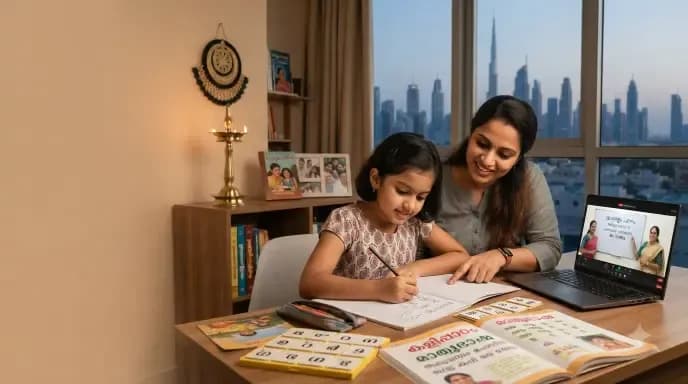
Challenges Faced by NRI Children in Learning Malayalam and Practical Solutions
For NRI children from Malayali families, Malayalam is more than a language. It is a thread that connects children to their roots, their grandparents, and a culture they may only experience during holidays. Yet keeping that thread strong when your child grows up speaking English or another local language every single day is one of the most common struggles we hear from Malayali parents abroad.
In this blog, we discuss the real challenges NRI children face when learning Malayalam, what causes these difficulties, and how families and teachers can help overcome them to make progress in the language.
Why NRI Children Struggle with Malayalam
The difficulty NRI children face with Malayalam is not a matter of ability. It is a matter of environment. The brain deprioritises a language when it is not used in school, with friends, or in everyday life. The first step in dealing with it is to understand why it is so.
English or the local language dominates every major part of an NRI child's day. The language of instruction in school, discussions with peers, entertainment, and social media are not in Malayalam. The Malayalam language, on the other hand, is spoken only in the home and rarely. Even children who know the spoken language of Malayalam find it difficult to understand and learn to write the language without regular exposure.
Many NRI children also feel self-conscious about pronunciation errors, especially when visiting Kerala. That fear of judgement, however unspoken, creates a reluctance to try.
The Real Challenges: What We Commonly See
Families who come to us often describe the same set of difficulties. Recognising these patterns helps parents understand that their child's struggle is not unique and that targeted support genuinely works.
Dig deep: Weekend Malayalam Learning Plans for NRI Families in the UAE
Practical Solutions That Actually Work
The good news is that each of these challenges has a practical answer. What works is not one single method but a combination of environmental, digital, and structured approaches working together.
Creating a Malayalam Environment at Home
Small changes at home have a bigger impact than most parents expect. Setting aside a specific time each day, even twenty to thirty minutes, and using only Malayalam during that time creates familiarity through repetition. Grandparent video calls are more than just a means of connection. Children have opportunities to talk with fluent speakers regularly in a natural and emotionally positive context.
Praising effort rather than accuracy matters enormously at this stage. A child who tries and makes mistakes is building fluency. A child who stays silent to avoid errors is not.
Using Digital Tools Purposefully
Children learn to read and write Malayalam more easily if they are provided with both visual and auditory support. In the present day, children can now associate their sounds with language in a fun way through Malayalam cartoons and children’s television shows that include subtitles. Rhyming in Malayalam, audio stories while travelling or in a calm environment.
Language apps for Malayalam script practice allow children to play with the individual letters in a game format to reduce the stress of formal writing tasks.
Building the Right Phonetic Foundation
The child has to hear and articulate the sounds properly before he/she can read Malayalam. One of the best methods is physical practice with a playful approach. By teaching the tongue placement for difficult sounds through simple games, you take the strain off and make the instruction memorable. Transliteration, writing Malayalam words in the English alphabet, is an entry point for children to interact with the language before the script becomes a barrier.
You don’t have to have a formal study session to implement sticky note association games into your daily life. Pair Malayalam letters with common things around your house.
How a Clearly Structured Programme Makes the Difference
Home strategies can support Malayalam learning, but they work best when a child also follows a consistent programme. Irregular practice may build familiarity, but it rarely creates reading and writing confidence.
A clear curriculum gives children a steady path from recognising letters to forming words, writing sentences, and using Malayalam with greater independence both inside and outside the classroom.
A clearly structured programme helps by:
Small class sizes make this support even stronger. When a teacher works with a small group or an individual learner, every child receives more attention, more correction, and more useful feedback. This helps the child move forward with confidence instead of repeating the same mistakes.
Red Parrot Language Learning School: Here for Every NRI Family
At Red Parrot Language Learning School in Kakkanad, Kochi, we support NRI and Non Resident Keralite families who want their children to learn Malayalam from anywhere in the world. Our online Malayalam reading and writing classes are designed for children learning outside Kerala who need structure and encouragement to make real progress in their Malayalam learning journey.
Experienced instructors based in Kochi deliver every class live. We use activity based learning, worksheets, guided reading, writing practice, and regular progress updates to keep children engaged and parents informed.
If your child understands Malayalam but is not yet confident in reading or writing, we help them learn Malayalam with structure, patience, and regular practice. Contact us today to help your child build confidence in Malayalam reading and writing.
Leave a Reply
Your email address will not be published. Required fields are marked *
STAY CONNECTED WITH RED PARROT SCHOOL
Stay updated on new programs, resources and language learning insights

Information
- Red Parrot Language School.
- No. 4/461, 2nd Floor Suite No. 399 Valamkottil Towers Judgemukku, Kakkanad, Kochi, Kerala 682021
- info@redparrotschool.com
- 9037495104